

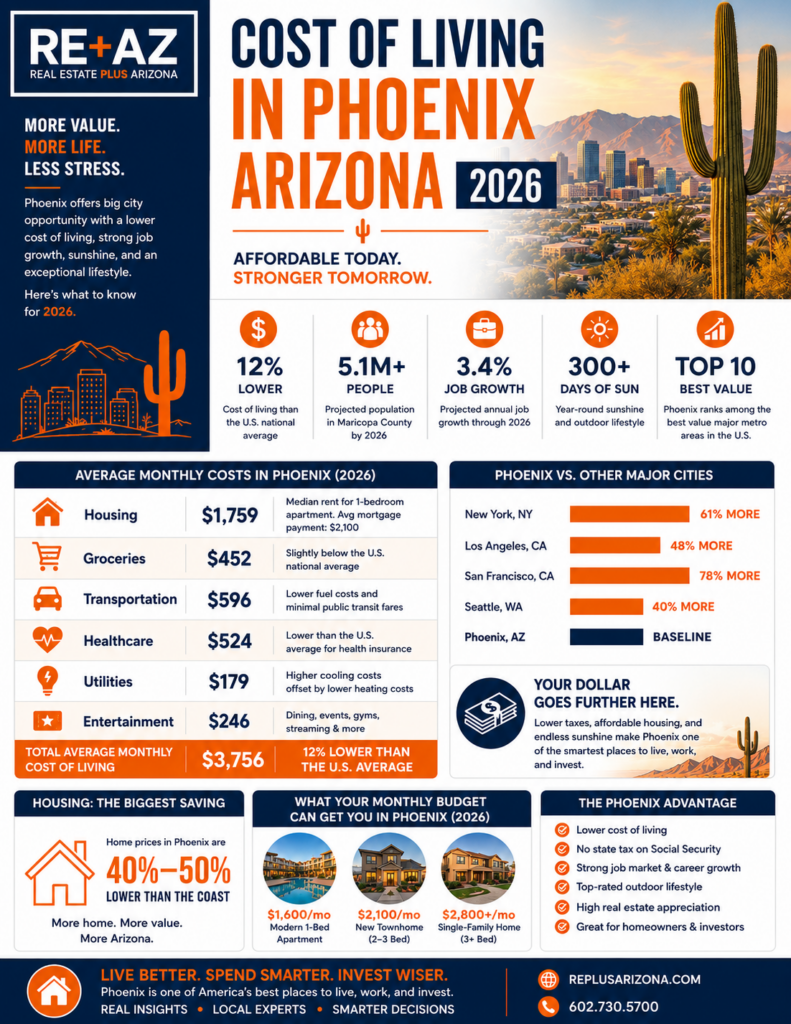
Cost of Living in Phoenix Arizona 2026
Phoenix is still one of the most important relocation, housing, and investment markets in the American Southwest. People move here for sunshine, jobs, lifestyle, lower taxes, outdoor recreation, and the chance to live in a major metro without feeling trapped by the cost structure of Los Angeles, San Francisco, Seattle, or New York.
But the real question is not simply, “Is Phoenix affordable?”
The better question is: “Affordable compared to what, and for whom?”
The cost of living in Phoenix Arizona in 2026 depends heavily on your housing choice, neighborhood, commute, lifestyle, loan type, and whether you are renting, buying, investing, or relocating from another state. Phoenix is no longer the ultra-cheap desert city it was decades ago, but it still offers a strong value proposition for many buyers and renters who want big-city opportunity with a more flexible Arizona lifestyle.
For anyone comparing Phoenix to other Arizona cities, the broader Arizona Real Estate Market Forecast is a smart place to start.
Is Phoenix Arizona Expensive in 2026?
Phoenix is more expensive than it used to be, but it is still generally more approachable than many major coastal metros. The biggest pressure point is housing. Rent, mortgage payments, insurance, utilities, and neighborhood selection will usually determine whether Phoenix feels affordable or stretched.
For a renter, the monthly cost of living may depend on whether they choose Downtown Phoenix, Tempe, Arcadia Lite, Chandler, Mesa, Glendale, or a more suburban location. For a buyer, the numbers depend on mortgage rates, down payment, property taxes, HOA fees, insurance, and how much home they are trying to purchase.
This is why cost of living should never be viewed as one flat number. A condo in Midtown Phoenix, a townhome in Tempe, a single-family home in Mesa, and a luxury home in Scottsdale all create very different monthly realities.
If you are deciding whether buying makes sense, start with How Much Do You Need to Buy a House in Arizona? before comparing neighborhoods.
Housing Is the Biggest Cost in Phoenix
Housing is the number one factor in the Phoenix cost of living equation. Everything else matters, but rent or mortgage payment usually controls the budget.
Renters in Phoenix may find better value than in coastal cities, but the most desirable locations still command premium pricing. Areas close to employment, nightlife, universities, hospitals, restaurants, and freeway access tend to cost more.
Buyers face a different calculation. A mortgage payment includes principal, interest, taxes, insurance, and sometimes HOA fees. That means the listed home price is only one part of the affordability picture.
For first-time buyers, the First-Time Home Buyer Arizona Guide is especially useful because it explains how to think through the buying process before getting emotionally attached to a home.
Phoenix Renters: What to Expect
Phoenix renters in 2026 should expect wide variation depending on neighborhood and property type. A newer apartment in Downtown Phoenix, Tempe, or Scottsdale will usually cost more than an older rental in Mesa, Glendale, or parts of West Phoenix.
The best rental value often comes from understanding lifestyle trade-offs. Paying more to live close to work may reduce transportation costs and improve quality of life. Paying less for more space farther out may make sense if you work remotely or do not need to be near the urban core.
For renters considering future ownership, the smartest move is to rent in a way that supports savings. A slightly less expensive apartment may be the difference between staying stuck and building a down payment.
If your goal is to eventually buy, review Arizona Down Payment Assistance Programs early instead of waiting until you are already shopping.
Phoenix Buyers: What Your Money Gets You
Phoenix still offers a range of housing options, but affordability depends on location. In general, buyers may find better value in Mesa, Glendale, Peoria, Surprise, and parts of Chandler than in premium Scottsdale, Arcadia, or central Phoenix pockets.
Condos and townhomes can be a practical entry point for buyers who want location more than square footage. Single-family homes may offer more privacy and long-term flexibility, but they usually come with higher maintenance responsibilities.
For buyers comparing lifestyle and budget, Best Places to Buy a Home in Arizona gives a broader view of how Phoenix fits into the larger statewide market.
Groceries, Utilities, and Everyday Costs
Groceries in Phoenix are usually manageable compared with more expensive coastal metros, but food costs still depend on household size, shopping habits, and how often you eat out.
Utilities are more complicated. Phoenix residents may save money during mild winter months, but summer electricity bills can be significant because air conditioning is not optional. A newer energy-efficient home may have much lower monthly utility costs than an older property with poor insulation, old windows, or an aging HVAC system.
This is one reason buyers should pay attention to the age of the roof, AC unit, windows, insulation, and appliances. A cheaper house with high monthly utility costs may not be as affordable as it looks.
Transportation Costs in Phoenix
Phoenix is a car-heavy metro. Some areas offer light rail access, bikeability, and walkable pockets, but most residents still rely on a vehicle.
Transportation costs include gas, insurance, maintenance, registration, parking, and commute time. Living farther from work may reduce housing costs but increase transportation costs. Living closer to employment may cost more upfront but improve time, lifestyle, and convenience.
This is especially important for people comparing Downtown Phoenix, Tempe, Midtown, Chandler, Scottsdale, and Mesa. The right location should match both your monthly budget and your daily routine.
For people focused on lifestyle and commute, the Tempe Real Estate Market Breakdown and Downtown Phoenix Living Guide are useful companion guides.
Best Phoenix Areas for Cost-Conscious Buyers
Not every Phoenix-area buyer needs the same neighborhood. Some buyers want the lowest monthly payment. Others want long-term appreciation. Others want school districts, commute access, rental potential, or lifestyle.
For value-focused buyers, Mesa, Glendale, Peoria, Surprise, and parts of Chandler may offer strong opportunities. Mesa remains especially important because it gives buyers access to the East Valley without always carrying the same pricing pressure as Scottsdale or Tempe.
The Mesa Housing Market Guide is a strong resource for buyers who want more space, practical pricing, and East Valley access.
Peoria and Surprise also deserve attention from buyers who want suburban value, newer homes, and more room. The Peoria Housing Market Guide and Surprise AZ Growth Trends both show why the northwest Valley continues to matter.
Best Phoenix Areas for Lifestyle Value
Lifestyle value is different from low cost. Some areas are more expensive but may still offer excellent value because of restaurants, jobs, walkability, entertainment, and long-term demand.
Tempe offers access to ASU, major employers, nightlife, light rail, and Tempe Town Lake. Midtown and Downtown Phoenix offer central access and urban energy. Scottsdale offers premium restaurants, nightlife, luxury housing, and lifestyle branding.
For buyers who want a strong mix of lifestyle and resale appeal, Scottsdale Real Estate Trends and Old Town Scottsdale Real Estate Guide are useful reads.
Is Phoenix Good for Investors in 2026?
Phoenix remains one of the most watched investor markets in the country because of population growth, job growth, rental demand, and long-term housing demand. But investors need to be more disciplined now than they were during the ultra-low-rate years.
Cash flow is harder when interest rates are higher. Insurance, repairs, property taxes, and maintenance must be analyzed carefully. The best investors are not simply buying because “Phoenix is growing.” They are buying specific properties in specific submarkets with a clear strategy.
If you are evaluating rental property, start with Is Arizona a Good Place to Invest in Real Estate? and Best Rental Markets in Phoenix.
For deeper numbers, Cap Rates in Phoenix Explained is essential because it helps investors understand income, expenses, and return expectations.
Cost of Living vs. Quality of Life
Phoenix is not just a spreadsheet decision. People move here because the lifestyle is powerful.
The Valley offers sunshine, hiking, golf, patios, resorts, spring training, lakes, desert trails, restaurants, and quick weekend access to Sedona, Flagstaff, Tucson, California, and Las Vegas.
That lifestyle matters. A city with slightly lower costs but fewer opportunities may not offer better value. Phoenix works because it combines job access, housing options, and lifestyle upside.
The strongest buyers and investors understand this balance. They are not just looking for cheap. They are looking for durable value.
Phoenix vs. Scottsdale, Tempe, Mesa, and Chandler
Phoenix is the center of the metro, but many people comparing cost of living are really comparing the entire Valley.
Scottsdale usually costs more but offers premium lifestyle appeal. Tempe offers strong young professional and rental demand. Mesa offers practical value and East Valley access. Chandler offers employment strength and suburban comfort. Glendale and Peoria offer more affordability in many cases.
Each market has a different cost profile.
Someone choosing between Phoenix and Tempe should read the North Tempe Real Estate Guide. Someone comparing premium lifestyle options should study North Scottsdale Luxury Market and Arcadia Real Estate Market.
FAQ: Cost of Living in Phoenix Arizona 2026
Is Phoenix affordable in 2026?
Phoenix is not as cheap as it once was, but it can still be affordable compared with many major coastal cities. Housing is the biggest factor. Buyers and renters who choose the right neighborhood for their budget can still find strong value.
What is the biggest expense in Phoenix?
Housing is usually the largest monthly expense in Phoenix. Rent, mortgage payments, insurance, property taxes, HOA fees, and utilities will usually determine whether Phoenix feels affordable.
Are utilities expensive in Phoenix?
Summer electricity bills can be high because air conditioning is essential. However, newer energy-efficient homes, updated HVAC systems, good insulation, and solar options may help manage utility costs.
Is Phoenix cheaper than Scottsdale?
In most cases, Phoenix offers more affordable options than Scottsdale, especially outside premium central neighborhoods. Scottsdale generally commands higher pricing because of lifestyle, schools, luxury housing, restaurants, and brand appeal.
Is it better to rent or buy in Phoenix in 2026?
Renting may make sense if you need flexibility. Buying may make sense if you plan to stay, have stable income, and understand the full monthly payment. The right answer depends on your income, debt, savings, neighborhood, and timeline.
Is Phoenix good for first-time buyers?
Yes, Phoenix can be a strong market for first-time buyers, especially when they compare neighborhoods carefully and understand loan options. FHA loans, VA loans, and down payment assistance may help some buyers enter the market.
Is Phoenix a good place to invest in real estate?
Phoenix can be a strong investment market, but investors need to analyze cash flow, rent demand, expenses, cap rates, and neighborhood fundamentals. The market rewards disciplined investors more than emotional buyers.
The Bottom Line
The cost of living in Phoenix Arizona in 2026 is not just about whether the city is cheap or expensive. It is about value.
Phoenix gives residents access to jobs, sunshine, outdoor lifestyle, restaurants, real estate options, and long-term growth. Housing costs are higher than they used to be, but the Valley still offers multiple paths depending on your goals.
Renters can find flexibility. First-time buyers can find entry points. Move-up buyers can find lifestyle upgrades. Investors can find opportunity if they understand the numbers.
Phoenix is no longer a hidden bargain. But for people who choose strategically, it can still be one of the strongest lifestyle and real estate value markets in the Southwest.
Related Arizona Guides
Arizona Real Estate Market Forecast
Best Places to Buy a Home in Arizona
How Much Do You Need to Buy a House in Arizona?
First-Time Home Buyer Arizona Guide
Arizona Down Payment Assistance Programs
Best Rental Markets in Phoenix
Cap Rates in Phoenix Explained